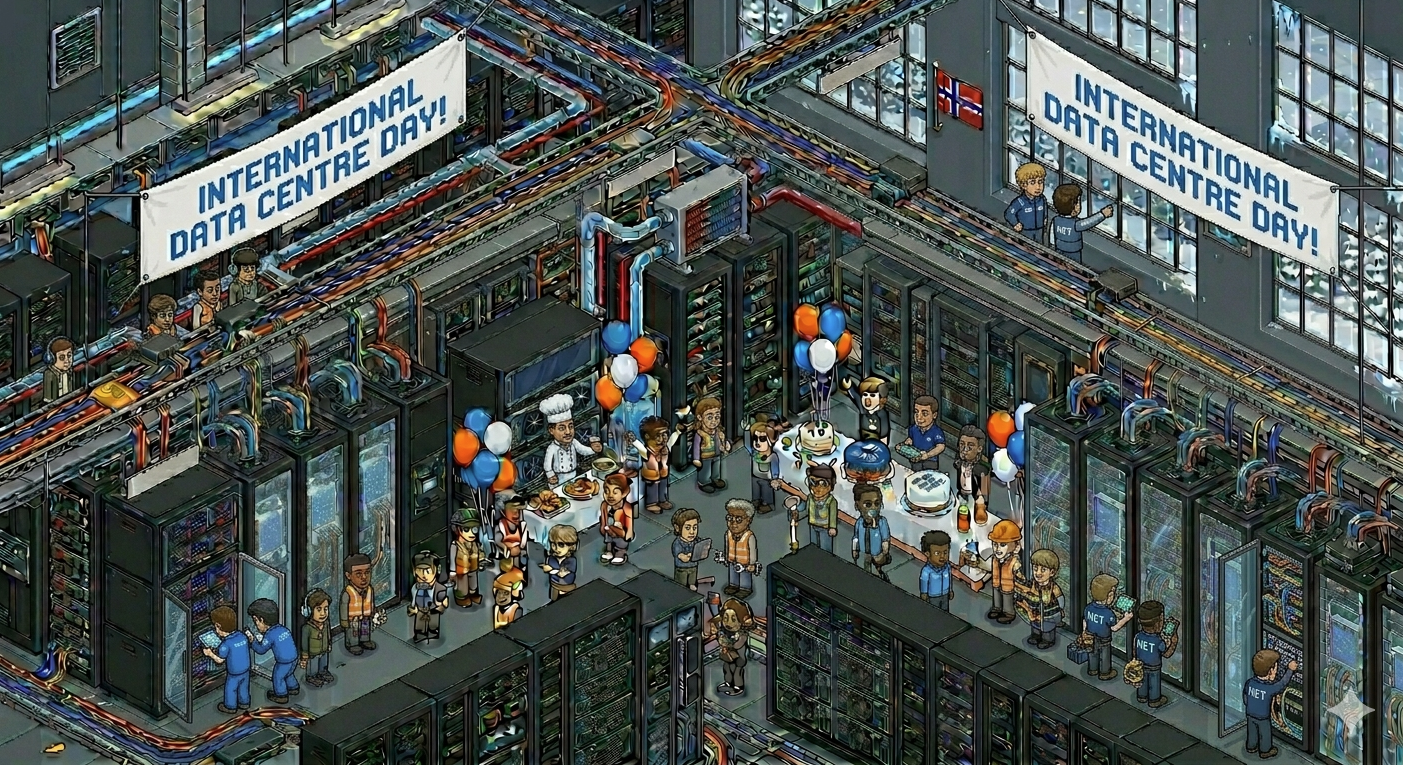
International Data Centre Day
I think we will start to see ‘AI Hub’ datacentres in a few years, in a similar way that Slough has become the home of finance in the UK. Equinix LD4, LD5, and LD7 didn’t end up there by accident — financial services, exchanges and interconnection are concentrated there due to the sweet spot of: proximity to the City of London, transatlantic to NY and low latency wireless.
A GPU rack can run at 50–100+ kW, versus the 5–10 kW you’d expect from a standard server rack. That’s not a different tenant in the same building; that’s a different building entirely! Different power infrastructure, different cooling approach (all components direct liquid cooling, as Arista demonstrated with the liquid-cooled R4 switches at Innovate 2025), different structural requirements.
The implication is that AI DCs will go where the power is, not necessarily where the people are. Unlike HFT, where single-digit millisecond latency to an exchange is a hard commercial requirement, AI is more about distributed facilities, power contracts and fibre backhaul. Norway and Iceland have been attracting neocloud and hyperscaler investment for exactly this reason — the environment makes liquid cooling even more efficient.
The “AI Hub” clustering is already starting — neocloud companies are emerging, as well as the existing hyperscalers quietly securing massive power agreements and building huge facilities in specific corridors. The contracts being signed now are long-term; the geography is already being committed to. In a decade, what is currently strategic will simply be the map — as legible and deliberate as the Slough finance corridor is today, but with GPU availability and power contracts as the selection criteria rather than exchange proximity. The infrastructure map is being redrawn, and International Data Centre Day feels like a reasonable moment to notice it happening.